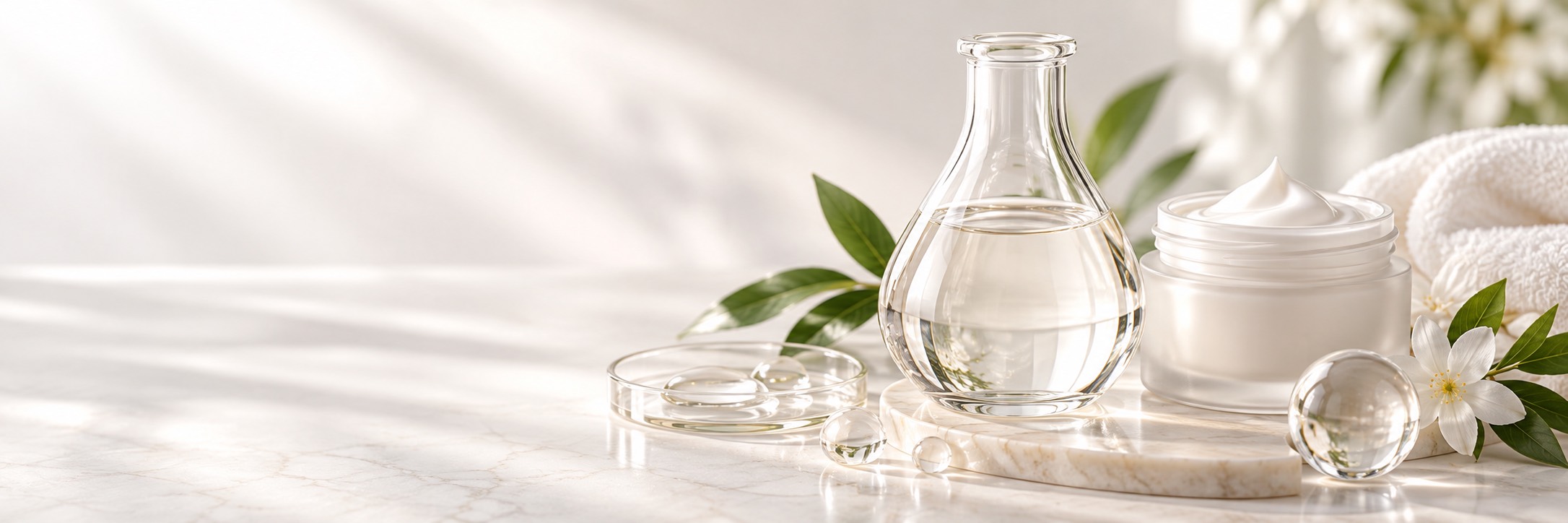

ฮงฮวด
15 September, 2026
Share this article


Why Is “White Oil” an Essential Ingredient Used by Skincare Brands Worldwide
Why Is “White Oil” an Essential Ingredient Used by Skincare Brands Worldwide?
In today’s highly competitive skincare market, brands are constantly looking for new active ingredients and botanical extracts to differentiate their products. At the same time, fundamental factors such as texture, after-feel, formulation stability, and the ability to help reduce moisture loss from the skin remain important elements that influence the overall consumer experience.
One of the long-established ingredients widely used in skincare and personal care products is White Oil, also known as Highly Refined Mineral Oil. It is an emollient that helps leave the skin feeling soft and smooth while forming a protective film on the skin surface to help reduce moisture loss.
Scientific reviews have reported that Mineral Oil used in cosmetic products can provide skin-protective benefits and help reduce Transepidermal Water Loss (TEWL). It also offers high stability compared with oils that are more susceptible to oxidation.
What Is White Oil?
White Oil, or Mineral Oil, is a mixture of hydrocarbons that has undergone refining and purification processes to achieve a level of quality and purity appropriate for its intended application. It is available in various grades and viscosity ranges to meet different formulation requirements.
For cosmetic applications, Highly Refined Mineral Oil is commonly selected based on the required quality specifications, purity, viscosity, and applicable standards.
One of the key advantages of White Oil is its high chemical stability. Unlike some plant-based oils that contain unsaturated fatty acids and may be more susceptible to oxidation, highly refined Mineral Oil is highly resistant to oxidation and does not readily become rancid.
Why Does White Oil Remain a Popular Ingredient in the Skincare Industry?
1. Helps Reduce Moisture Loss and Improve Skin Feel
One of the key functions of White Oil in skincare formulations is its role as an Emollient and Occlusive Ingredient.
When applied to the skin, White Oil can form a thin film on the skin surface, helping to reduce Transepidermal Water Loss (TEWL) and supporting the skin’s ability to retain moisture.
It can also help smooth the skin surface, leaving the skin feeling soft, smooth, and supple after application.
White Oil is therefore commonly used in formulations such as:
Moisturizers and face creams
Body lotions and body creams
Baby care products
Cleansing products
Lip care products
Hand creams
Skin protectant products
2. High Stability and Resistance to Oxidation
Another important advantage of White Oil is its high chemical stability.
Many natural oils contain fatty acids that can undergo oxidation when exposed to oxygen, light, or heat. This may affect the odor, color, and overall quality of a formulation over time.
In contrast, properly refined Mineral Oil offers high oxidative stability and is not prone to rancidity.
This property is particularly beneficial for formulators, as it can contribute to consistent formulation quality and product stability.
White Oil can also be used in combination with a wide range of other ingredients, giving formulators greater flexibility when balancing formulation performance and sensory properties.
3. Long-Established Use and Extensive Safety Data
Some consumers have concerns about Mineral Oil, particularly regarding irritation, sensitivity, or pore clogging.
However, it is important to distinguish between highly refined Mineral Oil intended for cosmetic applications and Mineral Oil that does not meet the appropriate purity requirements for such use.
Scientific reviews of cosmetic Mineral Oil indicate that these materials are primarily retained within the outermost layer of the skin, known as the Stratum Corneum, with relatively limited penetration into deeper layers of the skin.
Mineral Oil also has a long history of use in skincare and personal care products, supported by extensive safety data for topical applications.
When selecting raw materials for cosmetic formulations, however, it is important to consider the grade, purity, specifications, and applicable quality standards of the material and manufacturer. Not all Mineral Oils should be considered identical.
4. Helps Formulators Control Product Texture and Sensory Profile
For formulators, White Oil is not simply an ingredient for improving skin softness. It can also be an effective tool for adjusting the sensory profile of a formulation.
White Oil is available in different viscosity grades, allowing formulators to select a grade according to the desired product characteristics, from lighter textures that spread easily to richer formulations with a more substantial skin feel.
When combined with other Emollients, Esters, Natural Oils, Waxes, and Humectants, White Oil can help fine-tune:
Spreadability
Skin softness
Occlusive or protective feel
Cream consistency
After-feel
This versatility is one of the reasons why White Oil continues to play an important role in the development of skincare and personal care products
5. Provides Flexibility in Formulation Development
Modern skincare formulation is not simply about selecting one particular ingredient. Instead, formulators need to consider how different ingredients work together to achieve the desired performance and sensory experience.
White Oil can be combined with a wide range of ingredients, including Natural Oils, Plant Extracts, Humectants, Emulsifiers, and Active Ingredients, to create well-balanced formulations.
For example, a formulation may use Natural Oils to support a botanical or natural product positioning, while incorporating White Oil to provide Emolliency, Occlusivity, Skin Feel, and formulation stability.
This approach allows formulators to develop products that balance performance, sensory properties, formulation stability, and cost.
White Oil vs. Natural Oil: It Does Not Have to Be One or the Other
Choosing between White Oil and Natural Oil is not necessarily about which one is “better.” Instead, it is about selecting the right ingredient for the desired function within the formulation.
Natural Oils can support product positioning based on their natural origin and specific composition. They may also provide unique properties and sensory characteristics depending on the type of oil used.
In contrast, White Oil offers key advantages such as high stability, consistent quality, high purity, and desirable Emollient and Occlusive properties.
Therefore, an effective formulation may incorporate both types of oils at appropriate levels to achieve the desired product performance and consumer experience.
Why Does White Oil Continue to Matter in the Skincare Industry?
Although the cosmetics industry continues to introduce new technologies and innovative Active Ingredients, White Oil remains a widely used raw material because of its ability to support several fundamental aspects of formulation development.
✔ Helps reduce moisture loss from the skin
✔ Helps leave the skin feeling soft and smooth
✔ Offers high chemical and oxidative stability
✔ Has a long history of use in skincare and personal care products
✔ Is available in various viscosity grades for formulation flexibility
✔ Helps optimize product texture and sensory properties
✔ Can be used in combination with Natural Oils and Active Ingredients
Ultimately, a successful skincare formula is not necessarily about choosing the “newest” ingredient, but about selecting the right ingredients for the right functions.
White Oil continues to be an important formulation ingredient, helping formulators develop products that deliver quality, stability, desirable texture, and a positive consumer experience.
White Oil for Cosmetic & Personal Care Applications
For cosmetic and personal care manufacturers, selecting the right White Oil requires consideration of grade, viscosity, specifications, purity, and applicable quality standards, together with appropriate quality and regulatory documentation from the manufacturer.
Hong Huat supplies raw materials for the Cosmetic, Personal Care, and related industries, providing product information, specifications, and supporting documentation to assist with formulation development.
If you are looking for White Oil / Mineral Oil for skincare, cosmetics, or personal care formulations, please contact the Hong Huat team to discuss the appropriate grade and specifications for your application.
Related Posts
21 Oct 2026
Clove Oil: The Charm of Spicy Aromas in Product Innovation
Clove Oil: The Charm of Spicy Aromas in Product Innovation Clove Oil is a distinctive natural ingred...
16 Oct 2026
Menthol Crystal: The Essence of Intense Cooling Freshness
Menthol Crystal: The Essence of Intense Cooling Freshness Elevate Your Formulations with Natural Men...

16 Oct 2026
What Is Camphor? A Deep Dive into Its Properties, Mechanism of Action, and Applications
Getting to Know Camphor: The Science Behind Its Distinctive Aroma Camphor is a familiar ingredient f...