
ฮงฮวด
24 February, 2026
Share this article


Paraffin Wax VS Microcrystalline Wax
Paraffin Wax vs. Microcrystalline Wax: Understanding the Differences
Paraffin Wax and Microcrystalline Wax are petroleum-derived waxes that are widely used across various industries, including candles, cosmetics, food, pharmaceuticals, packaging, and surface coatings.
Although both waxes originate from petroleum refining processes, they have distinct crystal structures and physical properties. Understanding these differences can help manufacturers select the most suitable raw material for their applications and optimize overall product performance.
What Is Paraffin Wax?
Paraffin Wax is a wax characterized by a relatively large crystal structure, providing good hardness and a clean appearance. It is also available in a wide range of grades and melting points, making it suitable for many industrial applications.
Key Properties of Paraffin Wax
High purity
White or translucent appearance
Low odor
Available in various grades and melting points
Good burning performance
Cost-effective
Common Applications
Candle Manufacturing
Packaging
Hot Melt Adhesives
Rubber & Tire Applications
Food Coatings
Paraffin Wax is particularly suitable for applications that require a hard structure, rigidity, and good burning performance.
What Is Microcrystalline Wax?
Microcrystalline Wax has a fine and small crystal structure, which gives it greater toughness and flexibility compared with Paraffin Wax.
Key Properties of Microcrystalline Wax
High toughness and flexibility
Generally higher oil retention
Good adhesion
Good moisture and water resistance
Softer and more pliable texture
Good stability
Common Applications
Cosmetics & Personal Care
Pharmaceuticals
Adhesives
Coatings
Waterproofing
Microcrystalline Wax is particularly suitable for applications that require flexibility, adhesion, moisture resistance, and a softer texture.
Key Differences Between Paraffin Wax and Microcrystalline Wax
Crystal Structure
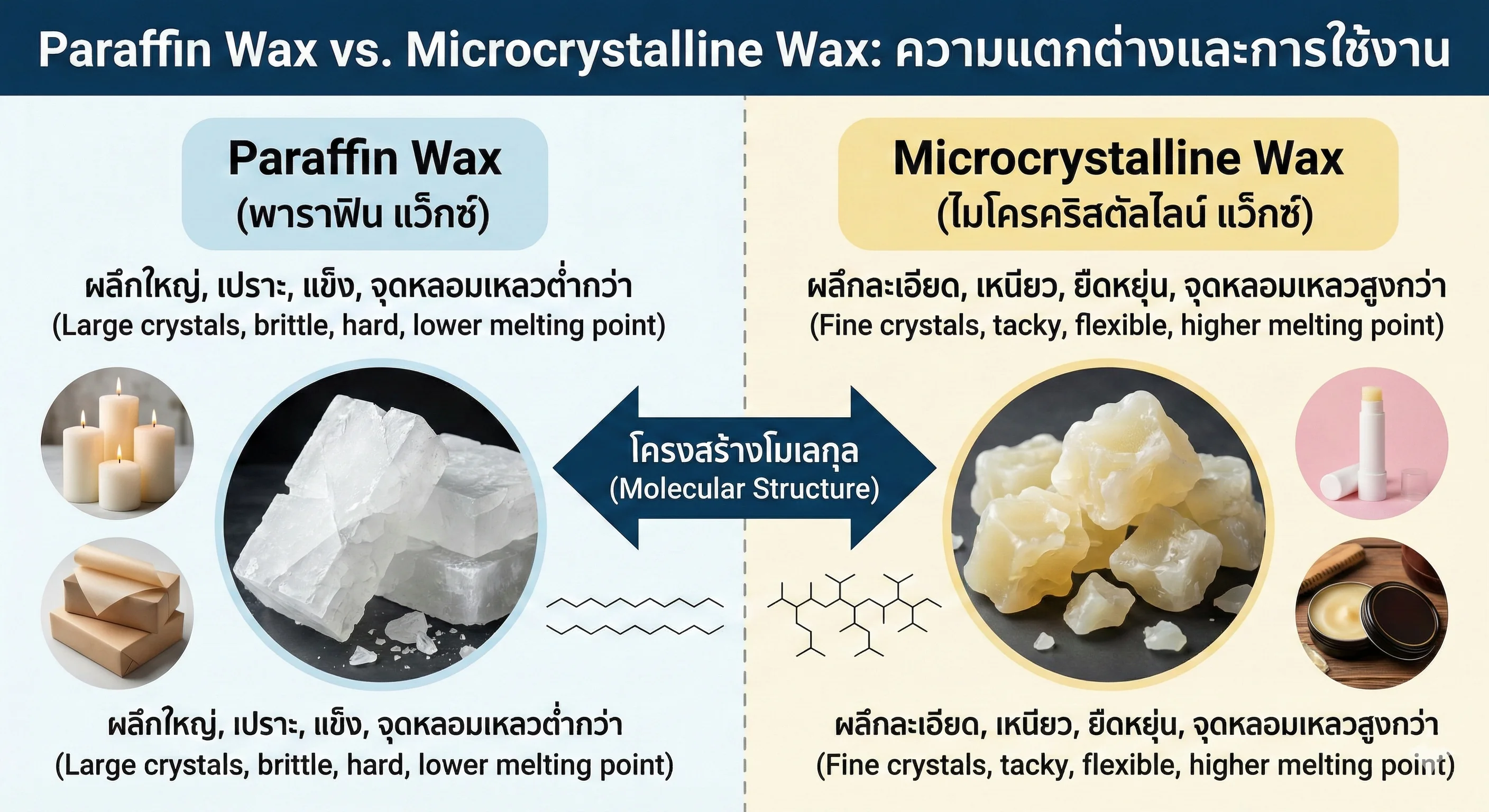
Paraffin Wax has a relatively large crystal structure, while Microcrystalline Wax has a finer and smaller crystal structure.
Hardness
Paraffin Wax is generally harder and more brittle, whereas Microcrystalline Wax is softer and more flexible.
Tackiness and Flexibility
Paraffin Wax generally has lower tack and flexibility, while Microcrystalline Wax offers greater toughness, tackiness, and flexibility.
Oil Content
Paraffin Wax generally has a lower residual oil content, while Microcrystalline Wax typically has a higher oil content.
Adhesion
Microcrystalline Wax generally provides better adhesion than Paraffin Wax, making it suitable for applications such as adhesives and coatings.
Water Resistance
Microcrystalline Wax generally provides better moisture and water resistance than Paraffin Wax.
Cost
Paraffin Wax is generally more cost-effective, while Microcrystalline Wax tends to have a higher cost due to its enhanced performance characteristics.
Choosing the Right Wax for Your Application
Choose Paraffin Wax When You Need:
Cost-effective performance
A hard and rigid structure
Good burning performance
Applications such as candle manufacturing and packaging
Choose Microcrystalline Wax When You Need:
Greater flexibility and toughness
A softer and more pliable texture
Applications in cosmetics or pharmaceuticals
Enhanced adhesion and moisture resistance
Blending Waxes to Enhance Product Performance
In many industries, Paraffin Wax and Microcrystalline Wax can be blended to achieve a balance of different performance characteristics, such as:
Hardness
Flexibility
Scent throw
Texture
Stability
Examples
Candles: A blend of Paraffin Wax and Microcrystalline Wax can be used to improve overall candle performance and modify properties such as hardness and flexibility.
Lipsticks: Adding Microcrystalline Wax can help enhance structure, texture, and product stability.
Trends in the Industrial Wax Market
Today's industrial wax market is increasingly focused on:
Higher product performance
Premium-quality products
Sustainability
Custom formulations
Many manufacturers are looking for raw materials that can be tailored to specific formulation requirements. Microcrystalline Wax plays an important role in developing specialized products that require enhanced flexibility, adhesion, texture, and stability.
Conclusion
Paraffin Wax and Microcrystalline Wax offer distinct properties and performance characteristics. Selecting the right wax—or combining both in an optimized formulation—can help manufacturers improve product performance, control costs, and create a competitive advantage in the industrial market.
Need Help Choosing the Right Wax for Your Product?
The Hong Huat team can provide guidance on:
Selecting the appropriate wax grade
Developing application-specific formulations
Choosing waxes for different industrial applications
📩 Contact our sales team for product recommendations and quotations:
Email: wholesale@honghuat.com
Related Posts

21 Oct 2026
Clove Oil: The Charm of Spicy Aromas in Product Innovation
Clove Oil: The Charm of Spicy Aromas in Product Innovation Clove Oil is a distinctive natural ingred...

16 Oct 2026
Menthol Crystal: The Essence of Intense Cooling Freshness
Menthol Crystal: The Essence of Intense Cooling Freshness Elevate Your Formulations with Natural Men...

16 Oct 2026
What Is Camphor? A Deep Dive into Its Properties, Mechanism of Action, and Applications
Getting to Know Camphor: The Science Behind Its Distinctive Aroma Camphor is a familiar ingredient f...