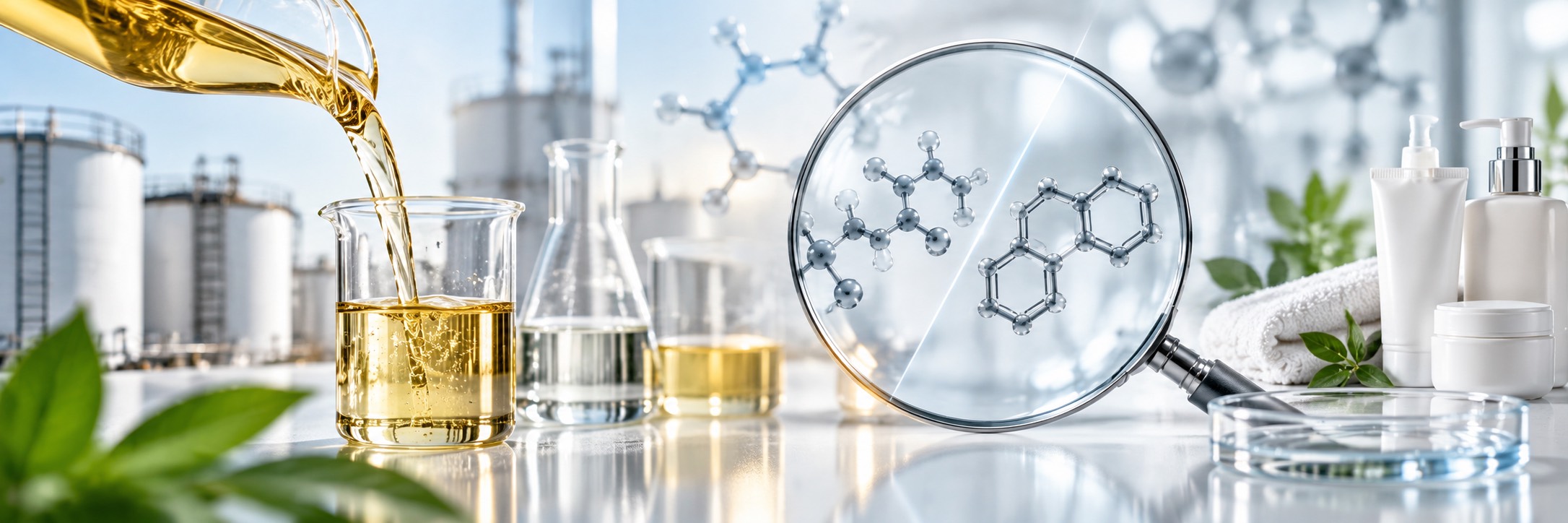

ฮงฮวด
27 November, 2025
Share this article


Understanding MOSH/MOAH in Mineral Oil: Are They Really a Health Concern?
MOSH/MOAH in Mineral Oil: Understanding the Safety Concerns
Have you ever wondered whether Mineral Oil, also known as White Oil, commonly found in everyday products such as baby oil, skin creams, and lip balms, is truly safe to use?
You may have heard the terms MOSH and MOAH and concerns that these substances may be harmful or even potentially carcinogenic.
But how much of this is actually true? Why do some sources consider mineral oil safe, while others raise concerns about its potential health effects?
This article aims to address these questions by explaining the technical aspects of MOSH and MOAH in a clear and straightforward way, helping you understand what they really are and, more importantly, which factors play the most important role in determining the safety of mineral oil products.
What Exactly Are MOSH and MOAH?
The terms MOSH and MOAH can sometimes cause confusion. They do not refer to specific mineral oil products sold on the market. Instead, they describe groups of hydrocarbon compounds that may be present in mineral oil and other petroleum-derived materials.
They are generally classified into two main groups:
Mineral Oil Saturated Hydrocarbons (MOSH)
Mineral Oil Aromatic Hydrocarbons (MOAH)
It is also important to note that hydrocarbons within these analytical groups are not found exclusively in petroleum-derived products. Similar compounds can naturally occur in vegetable oils, fruits, and vegetables.
MOAH: Is It Really the “Bad Guy”?
MOAH is often considered an important indicator when assessing the presence of potentially undesirable aromatic hydrocarbon components in mineral oil products intended for applications such as food, pharmaceutical, and cosmetic use.
However, from a technical perspective, MOAH represents a broad analytical group rather than a single substance. Measuring total MOAH does not identify which specific compounds are present or whether they are hazardous.
Certain polycyclic aromatic compounds (PACs), particularly those containing 3–7 aromatic rings, are known to have carcinogenic potential. Therefore, the presence and composition of these compounds are important considerations when evaluating the safety of mineral oil.
MOAH Can Be Considered in Two Broad Groups
3–7 ring Polycyclic Aromatic Compounds (PACs) – Certain compounds in this group may have carcinogenic potential.
Highly Alkylated Aromatic Compounds with 1–2 rings – These compounds are generally considered to have a substantially different toxicological profile from carcinogenic high-molecular-weight PACs.
This is why the refining process plays a critical role in mineral oil safety.
High-quality refining is designed to remove or reduce undesirable aromatic compounds, including potentially carcinogenic PACs. As a result, the level and effectiveness of refining, together with the quality and purity of the finished product, are critical factors when evaluating safety—not simply the total MOAH value alone.
Therefore, a detectable MOAH result does not, by itself, establish that a mineral oil product is unsafe. The composition of the MOAH fraction and the quality of the refining process must also be considered.
What About MOSH? Should We Be Concerned?
MOSH is another analytical group that has received attention in toxicological studies because certain mineral oil hydrocarbon fractions can accumulate in tissues, particularly the liver and lymph nodes.
However, MOSH is not a single chemical substance. It represents a broad group of saturated hydrocarbons measured through analytical techniques such as chromatography. The composition of MOSH can vary considerably depending on the source and refining process of the oil.
Some toxicological concerns regarding MOSH have been associated with animal studies, particularly findings observed in specific experimental models. However, these findings cannot automatically be directly extrapolated to humans.
In particular, certain responses observed in Fischer 344 rats have been associated with specific hydrocarbon components. Similar hydrocarbons can also naturally occur in substances such as olive oil and fruit waxes.
Therefore, the mere detection of MOSH in human tissues should not automatically be interpreted as evidence of a pathological condition or direct adverse health effects in humans. The specific composition, exposure level, route of exposure, and toxicological characteristics of the individual components must all be taken into account.
So, Where Does the Safety of Mineral Oil Really Come From?
The analysis of MOSH and MOAH is an important analytical tool, but these measurements should not be interpreted in isolation when determining the overall safety of a mineral oil product.
Several factors should be considered, including:
The degree and effectiveness of refining
Purity and composition of the finished product
Quality control during manufacturing
Intended application and route of exposure
Applicable regulatory and industry standards
Toxicological characteristics of the specific hydrocarbon components
For this reason, not all mineral oils are the same.
Highly refined mineral oils manufactured under controlled processes and meeting applicable regulatory and quality requirements can be used in a wide range of applications, including food, pharmaceutical, and cosmetic products, subject to the relevant regulations and specifications.
Conclusion: Don't Judge Mineral Oil by MOSH/MOAH Alone
When it comes to mineral oil safety, the key question is not simply “Does it contain MOSH or MOAH?”
Instead, the more important questions are:
What is the composition of these fractions? How effectively has the oil been refined? What quality standards does the product meet? And what is the intended application and level of exposure?
Understanding these factors provides a more accurate and scientifically sound approach to evaluating the safety of mineral oil products.
High-Quality Mineral Oil for a Wide Range of Applications
Hong Huat Co., Ltd. is an authorized distributor of products from Sonneborn LLC, a leading manufacturer of highly refined petroleum-derived products.
Our portfolio includes White Mineral Oils and Petrolatum manufactured under controlled refining and quality systems and available in grades designed for various applications.
These products can be used across a wide range of industries, including:
Cosmetics | Personal Care | Healthcare | Pharmaceuticals | Textiles | Plastics | Rubber | Paints & Coatings | Industrial Applications
We carefully select products based on quality, consistency, and suitability for each application, providing customers with reliable solutions and technical support.
Interested in Mineral Oil or Petrolatum?
Contact our team for more information or technical consultation:
Related Posts
21 Oct 2026
Clove Oil: The Charm of Spicy Aromas in Product Innovation
Clove Oil: The Charm of Spicy Aromas in Product Innovation Clove Oil is a distinctive natural ingred...

16 Oct 2026
Menthol Crystal: The Essence of Intense Cooling Freshness
Menthol Crystal: The Essence of Intense Cooling Freshness Elevate Your Formulations with Natural Men...

16 Oct 2026
What Is Camphor? A Deep Dive into Its Properties, Mechanism of Action, and Applications
Getting to Know Camphor: The Science Behind Its Distinctive Aroma Camphor is a familiar ingredient f...